
Fenton’s Cherries Banana Bowl in Cobalt Blue
by Sandy Whaling
Originally published in: The Carnival Pump, Vol. XXXIX No. 2 (December 2004)
Several years ago, I began collecting carnival glass pieces in blue or amethyst, sometimes green. The shimmering iridescence just caught my eye when a friend and I attended the Rose Bowl Flea Market one year. I knew nothing about carnival glass and made no effort to find out. In fact, I knew too little to know I didn’t know anything.
Over the years my collection of carnival glass has grown as I browsed antique shops during vacations. Still, I read nothing about carnival glass.
My husband retired a year ago and we moved to a little mountain community in the foothills of the Southern Sierra Nevada in the Great Central Valley of California. I began to browse through little antique shops in nearby towns once we unpacked. In Porterville, I came upon a small shop where two bluish iridescent vases caught my eye. I bought one and put the other on layaway. I had never in my life put something on layaway. When I returned to pay off and claim my second vase, the store owner told me she had a lovely old piece of carnival glass that I had completely overlooked. The piece was just exquisite and unusual.
The store owner explained that she was a certified appraiser and that this piece had come from an estate that she liquidated. She wanted $400 for it. This was awfully steep for me; I didn’t know anything about antique glass and was uncomfortable spending this kind of money. Again, the shop owner offered layaway and for the second time in my life I used that device to buy the bowl. The shop owner confessed that she was uncertain about the manufacturer but thought it might be Millersburg’s (her spelling) Hanging Cherries. We agreed to a layaway plan, and the shop owner urged me to take it home then and there. I was surprised, but happy to do just that.
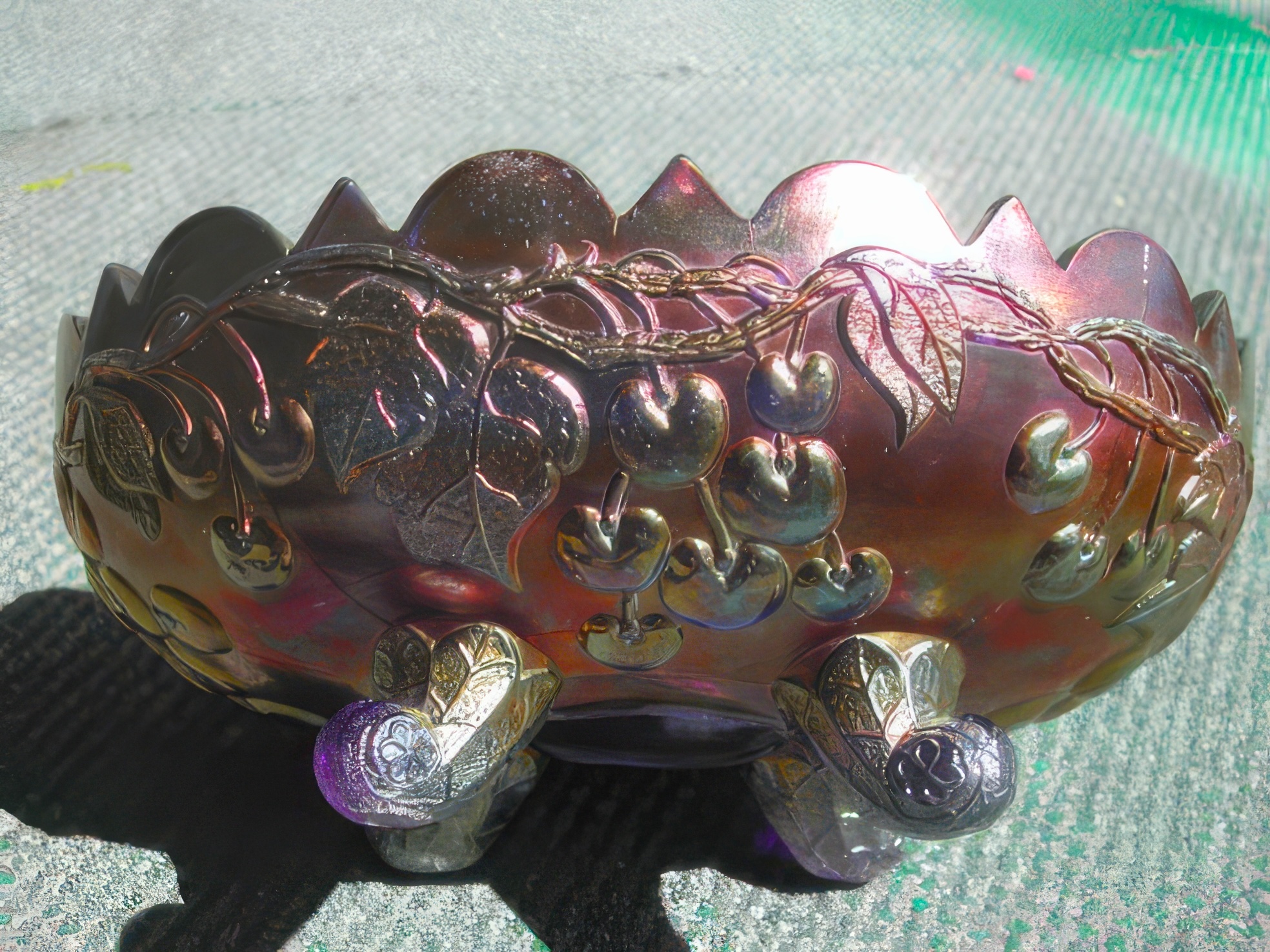
Once home with this beautiful bowl, I thought “Goodness, if I’m going to spend this kind of money for a piece of glass, I’d better find out what I’m doing.”
A new friend who owns another little antique store nearby had several books on antiques and collectibles. We both browsed those but didn’t find the bowl. She gets offers of books to buy with discounts if a certain number are purchased. So, we put in an order, three for her and three for me. I bought Edwards’ and Carwile’s 8th Edition of the Encyclopedia of Carnival Glass, Carnival Glass The Best of the Best, and their Companion Book. Although Fenton’s Cherries is found in the Encyclopedia, I missed it. I was perusing the Best of the Best book which led me to identify my bowl as Fenton’s Cherries. The bowl has a distinctive edging of scallops alternating with a triangular tooth shape. I was thrilled and intimidated at the same time.
Immediately, my reaction was that I owned something incredibly valuable if not priceless. I envisioned shades of The Antique’s Road Show where the host startles the unknowing guest telling him the item in granny’s attic is worth a quarter of a million dollars wherein the guest gasps, blanches, and comes close to fainting. I was in that state. The book, The Best of the Best, does not attempt to value pieces showcased, and I had not discovered the information in the Encyclopedia. My husband and I decided immediately to go down and pay off my layaway obligation, and I drove right down with the balance, shaking all the way and feeling a bit guilty that the shop owner had not known the true value of the piece when she sold it to me. I polled my friends and relatives about what was the right thing to do. The consensus was that I had not taken advantage of someone who was unschooled. The shop owner had held herself out to be a certified appraiser and had even suggested I hire her to evaluate my collection.
I set about trying to value my banana bowl. First, I e-mailed Mike Carwile, the co-author of the book. He was very gracious in getting back to me. He suggested I take the bowl to Peter Baerwald who is the Vice President of the Northern California Carnival Glass Association. Before this, I didn’t know clubs and associations even existed. As it turned out, the Association was having its convention in Fresno within a few weeks of my discovery and Mr. Baerwald was attending. Although my husband and I had other obligations that weekend, we went Thursday evening to see Mr. Baerwald. He examined the bowl and used a compound he makes himself to clean it. He explained how fragile the bowl, indeed most vintage carnival glass is, which was invaluable to me. He also discovered the internal fracture and gave us an estimate of its value. Another couple at the convention, Bill Curtis, the President of the Association, and his wife spent a good hour with us showing us their collection and explaining how they document their pieces and go about determining value for insurance purposes. The people we met were so gracious and helpful. For the first time, my husband and I saw truly exquisite examples of vintage carnival glass.
Since then, I’ve perused the internet and sent off inquiries to many collectors and dealers. I’ve floated back down to earth now and have come to the realization that I own something rare and beautiful, but not worth tons of money. That is a burden lifted. Before, I came close to putting this bowl in a safety deposit box. I’ve read the encyclopedia, obtained David Doty’s book, and became a faithful watcher of eBay where I try to get a feel for what is collectible and what buyers are actually paying. I’ve also appraised my own collection and found I have mostly contemporary pieces; most I’ve overpaid badly for; and some are so inferior I want them gone after seeing the quality displayed at the Northern Carnival Glass Association. My Fenton Cherries banana bowl has opened a new world to me, and I’m enjoying it immensely. Now I have the bug. Now I’m an ardent, picky carnival glass collector. However, I do need to get myself in hand and come to a strategy rather than just wanting everything I see. How do you do that? Anyone know?